Order The Dirty Deal at Lefty’s on the Square — Arkansas gin, lemon, and two maraschino cherries that refuse to stay out of the way — and you’re drinking to a bad bargain struck in a Magnolia hotel bar in the spring of 1921. One envelope, three men, and a road south that may or may not have existed. Here’s the story we named it after.
A stop that wasn’t supposed to matter
Francis “Lefty” Miller didn’t come to Magnolia looking for a home. Louisiana was the destination. Magnolia, Arkansas was supposed to be a night’s stop and a tank of gas on the way there — twenty-odd miles of Columbia County road between him and a state line that, in 1921, was worth real money to anyone who could cross it quietly.
Arkansas had been dry since 1916. The Newberry Act closed the saloons a full four years ahead of the Volstead Act, and by 1917 the Bone Dry Law made it illegal even to receive liquor shipped in from somewhere else. That head start mattered. It meant that by the time the rest of the country caught up, South Arkansas already knew how this worked: who hauled what, which roads washed out, and which questions a man didn’t ask at the courthouse square.
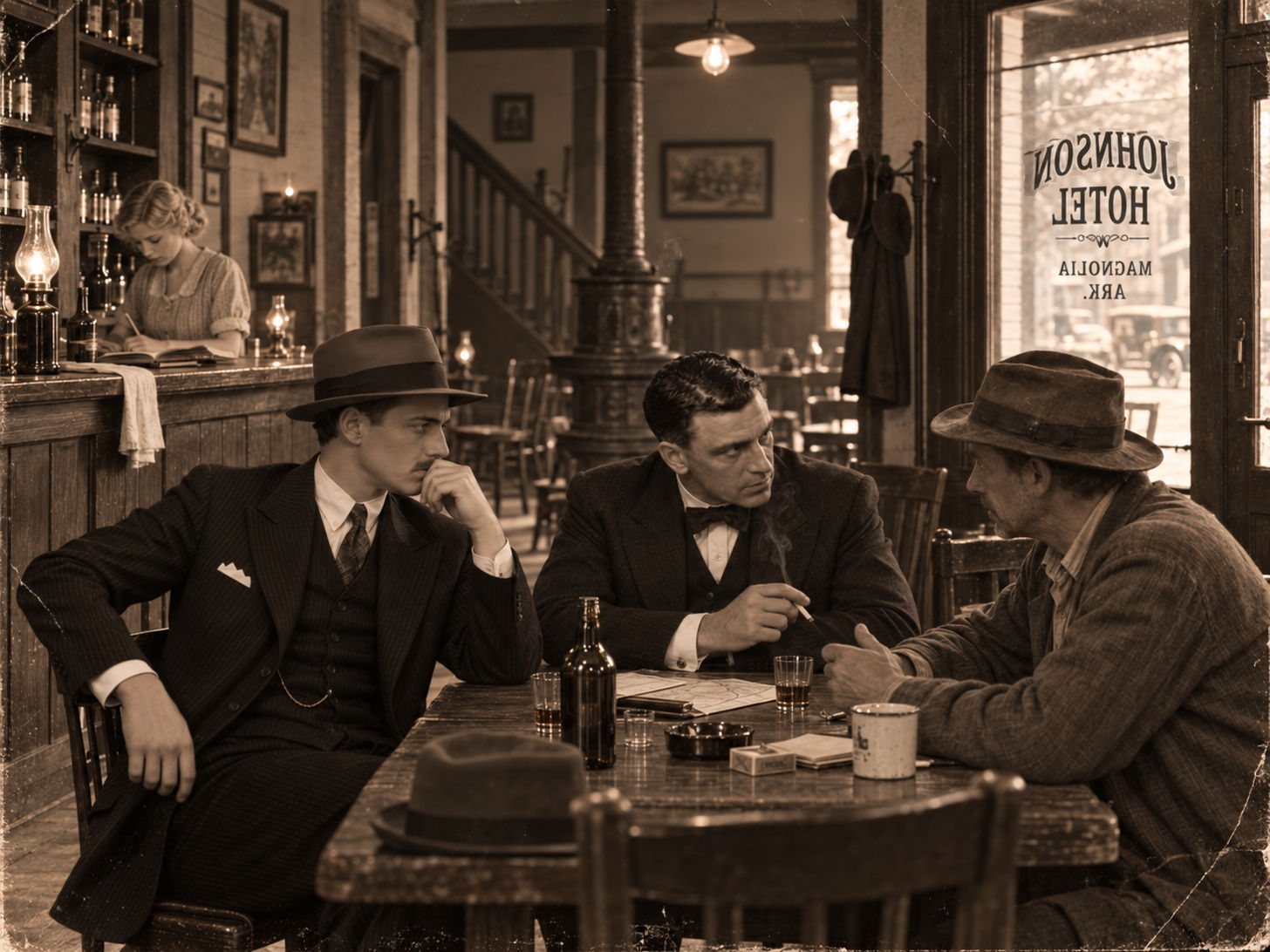
Chicago had taught Lefty that opportunity almost never announces itself. It shows up as a man who knows somebody. And in the front room of the Johnson Hotel, a local man sat down with an offer.
What was the Dirty Deal?
Not liquor. Access.
The man across the table said he could open a discreet corridor from Magnolia down into Louisiana — the roads that stayed passable after rain, the drivers who could move freight without anyone bothering to remember them, the places a load could sit for a day or two if weather or a deputy made it smarter to stop than to keep rolling. Most valuable of all, he said he knew who could be trusted, which in a county that size was a shorter list than it sounds.
For a man building a route, that kind of local knowledge was genuinely worth paying for. The only question was whether he actually had it.
A man who knew the roads
The Johnson Hotel bar wasn’t much. Tables scarred from twenty years of use, a bar top polished more by elbows than by varnish, a few electric bulbs splitting the work with oil lamps because the wiring only reached so far. Stella kept the books behind the counter while the men talked, and she did not once look up, which Lefty noted and filed away.
The local man described his route like a man reciting a psalm. He knew which roads south turned to soup after a hard rain. He knew where a truck could leave the main road without appearing to have left it. He had a driver who ran ordinary freight toward the line, and a second man farther down who’d take the load without asking what was under the canvas.
That was the whole appeal, and it was a good one. The safest shipment isn’t the one hidden in the dark — it’s the one so dull nobody bothers to remember it. Feed sacks, produce, a tired driver on another run through South Arkansas. Nothing worth writing down.
The things he wouldn’t say
Lefty listened. Hymie Weiss didn’t.
“Who’s the driver?”
The local man smiled. “You don’t need his name yet.”
“Where does the load sit if the road goes bad?”
“Safe enough.”
Hymie looked at him a long moment. “That isn’t what I asked.”
The man shrugged and reached for his glass, and that was the pattern for the next twenty minutes: every answer stopping half a step short of being useful. A driver, no name. A storage point, no location. A man waiting near the line who Lefty apparently didn’t need identified. Then the biggest promise of the afternoon — that the road would stay quiet — with no explanation of what quiet cost or who was being paid to keep it that way. Maybe he knew which deputy worked which stretch. Maybe he just understood how much ordinary traffic moved through Columbia County and figured that was protection enough.
What Lefty actually noticed was simpler. The man had been vague about everything except the money.
The price of safe passage
The number wasn’t outrageous, which is probably what made it dangerous. Part up front, the rest after the first load crossed into Louisiana. In exchange: drivers who’d appear, roads that would stay quiet, and anyone whose curiosity mattered finding something else to look at.
Nobody said anything for a second. Behind the bar, Stella turned a page. A glass touched wood, a chair scraped, and outside on the square Magnolia went on having an unremarkable Tuesday.
Lefty put the envelope on the table.
The local man reached for it a half-beat too fast — and caught himself, hand stopping in the air when he realized he’d been watched. He took it anyway. “Won’t be any trouble,” he said.
Lefty leaned back and smiled for the first time all afternoon. “Funny thing about a deal. You can tell a lot about a man by what he leaves out.”
Nobody laughed.
So what did he actually buy?
That’s the part nobody at the table could answer. Either they’d just bought the opening stretch of a quiet corridor south — local drivers, a place to wait out weather, a handshake waiting near the line — or they’d handed cash to a man who’d correctly identified two outsiders with full pockets and somewhere else to be by morning. You don’t find out until the first load moves.
He shook both their hands, put on his hat, and walked out with their money.
Hymie watched the door. “You believe him?”
“No.”
Lefty picked up his drink.
“But I believe he knows somebody.” Which, that particular spring, was worth the envelope by itself.
The deal before the empire
Everything that came later got bigger than one table. Liquor runs turned into legendary bars, and eleven years on there was enough of an operation for the law to come through the door of The 333 Club in 1932. But nothing like that starts as a network. It starts with one road, one driver, one person willing to say I know a way, and an envelope pushed across scarred wood toward a man you don’t entirely trust.
The Dirty Deal sits early in that arc. If you want the rest of it in order, start at Lefty’s Story.
Why we put it on the menu
The Dirty Deal is our tribute to that exact moment — the second where opportunity and suspicion are sitting in the same chair and you have to choose anyway. From the outside it looked clean. Three men, a little money, a promise that the road south would be easier from here.
The drink works the same way. It’s built on Tall Cotton Gin from Delta Dirt Distillery in Helena — the only Black-owned farm-to-bottle distillery in the country, run by the Williams family on ground their people have farmed for four generations in Phillips County. We shake it with fresh lemon and simple syrup over two maraschino cherries.
Poured, it looks clean enough. The cherries see to it that it doesn’t stay that way. The color goes cloudy toward the edge of the glass, and a drink that starts sharp and dry finishes sweeter and murkier than it began — which is more or less what happened at that table. We could have strained the cherries out. That would have been a different drink, and a different story.
Which is the lesson Magnolia kept teaching Lefty: what matters usually isn’t what a man tells you. It’s what he decides to leave out. The dirtiest deals are the ones that look cleanest going in.
Where to order the Dirty Deal
Lefty’s on the Square — 124 N. Court Square, Magnolia, AR 71753 · 870-901-3000
Thursday, Friday & Saturday 4–10 p.m.
Reserve a table · See the full cocktail menu · Join the 333 Club
Questions we get about the Dirty Deal
What’s in the Dirty Deal?
Tall Cotton Gin from Delta Dirt Distillery, fresh lemon juice, and simple syrup, shaken over two maraschino cherries. It’s a gin sour that doesn’t stay clean.
Is any of this true?
The world around it is. Arkansas went dry in 1916 under the Newberry Act, the Bone Dry Law followed in 1917, and Columbia County sat a short run from the Louisiana line for the next thirteen years. Chicago’s North Side Gang and Hymie Weiss were real. The meeting, the unnamed local contact, the route and all the dialogue are Lefty’s lore — our fiction, built on a real setting.
Do I need a reservation?
Not required, but Friday and Saturday fill up. Book a table or call 870-901-3000. More answers on our FAQs page.
Historical note: The Dirty Deal belongs to the narrative world of Lefty’s on the Square. The era, the regional context and the Prohibition timeline are accurate; the meeting, the local contact, the route arrangement and all dialogue are presented as lore rather than documented fact.